
You just don't know where to start.
Some workplace projects are straightforward. Many aren't. If you know you need a space solution but don't know where to start, Shaping is a great idea.
 Shape
ShapeShape is a pre-project method that brings multiple inputs together to help you work through open questions in your portfolio. Quickly get the answers you need to move forward, without committing to a project—all for completely transparent pricing.
Find Your Shape ↗Not kickoff, not visioning, but a short, structured call that sets the direction.
Optional if you’ve used Shape before.
60 min / $500Build, compare and iterate on scenarios in Prism, NELSON’s programming tool.
See it in action ↗60 min / $500Take your program and see it come to life as we design together in real time.
See it in action ↗Priced per spaceUnlimited iterations within a fixed window, plus one test-fit revision.
Window duration TBDA strategy brief, a program, and at least one block plan.
We hear it repeatedly: getting a workplace project started is difficult. There’s uncertainty about what’s needed, what it might cost, and whether it’s worth pursuing. Shape helps you work through those questions before making a larger investment.
Shape touches the key parts of a workplace project without turning the investigation into a project itself. You'll walk away with an optional strategic brief, a defined program, and a space plan that can be used as a basis for a test fit.
But you won't blow your budget.
Through real time design and the technology that makes it possible, we'll save you hours and dollars, giving you the information you need at a price that makes sense. Best of all, you'll control and know that price up front.
Some workplace projects are straightforward. Many aren't. If you know you need a space solution but don't know where to start, Shaping is a great idea.
For organizations with multiple locations and an established strategy, Shaping projects is a way to prioritize within your budget. You can compare opportunities, see what problems projects solve, and choose what moves forward.
Have empty space within your portfolio or building? Shape a project with us and see if it works as extra amenity space, room for a pilot project, or even something you could lease to another tenant.
Behind that question is often another: “Have you considered other options?” Shape helps you explore alternatives, understand their space implications, and demonstrate the thinking behind your recommendation.
Shape can help define what the client needs before—or during—the building search, giving you a clearer basis for evaluating candidate spaces.
The most successful workplaces reflect how an organization works and what it values. It can only be for them. But figuring that out in advance of a project doesn’t always require a lengthy strategy session. Maybe your strategy was set upstream, maybe it lives in one person's head and just needs to be explained, or maybe it's pretty straightforward.
That's why we invented kickoning. Kickoning combines the foundational elements of a kickoff call with the exploration of a visioning session. A true sprint, we'll say hello and then have a short, structured conversation about how you work and what your space needs to do...and that's it.
This session, using a method unique to NELSON, sets the stage for what's to come in the Shaping process, informing every step of the way. We'll refine it into a short strategy brief as one of the deliverables you'll walk away with.
Optional if you’ve used Shape before.
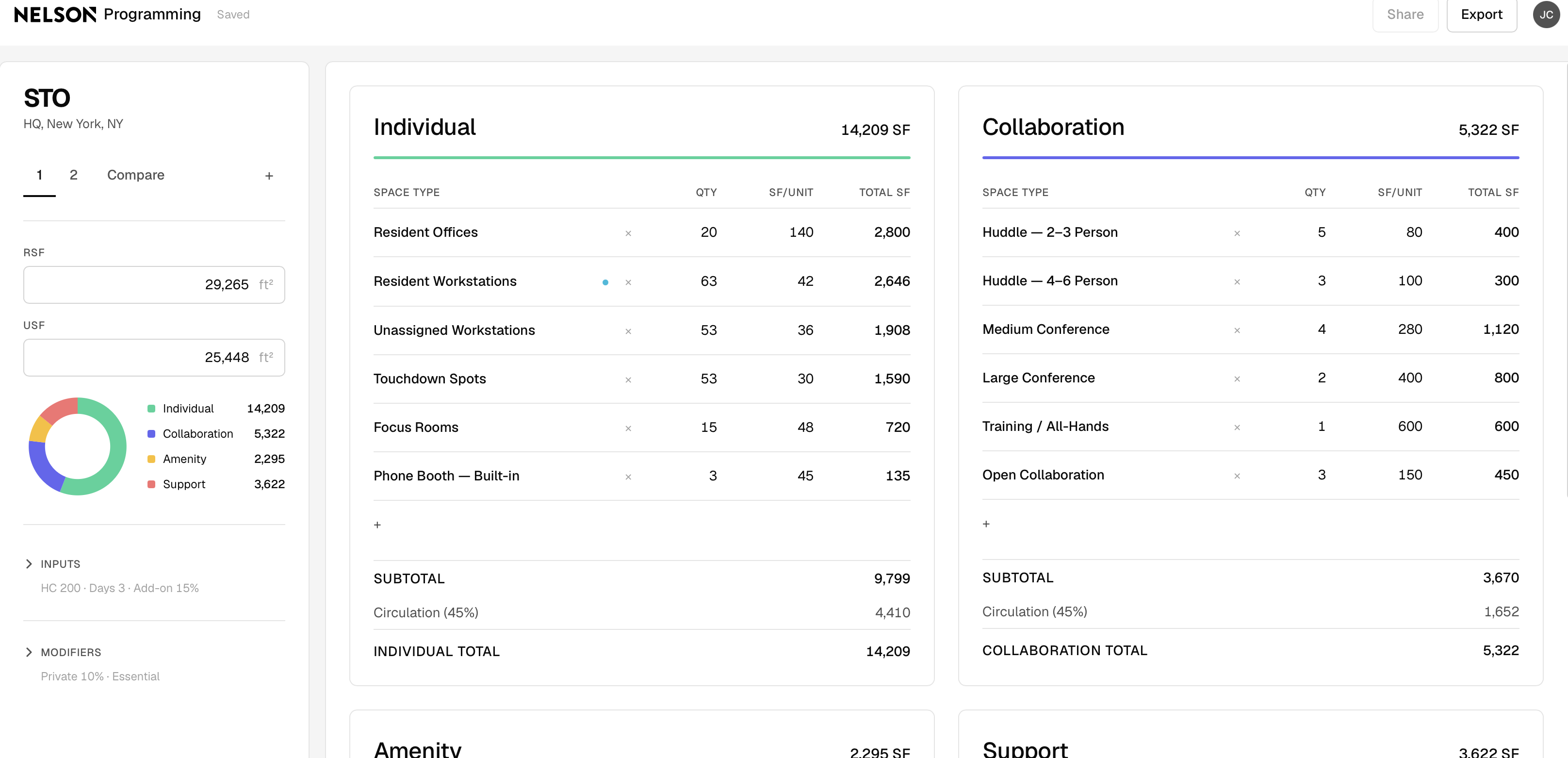
60 minutes · $500Find Your Shape →We use Prism, NELSON’s programming tool, in our 60-minute session. Start a program, customize every space type, and compare scenarios side by side. Every edit immediately recalculates square footage.
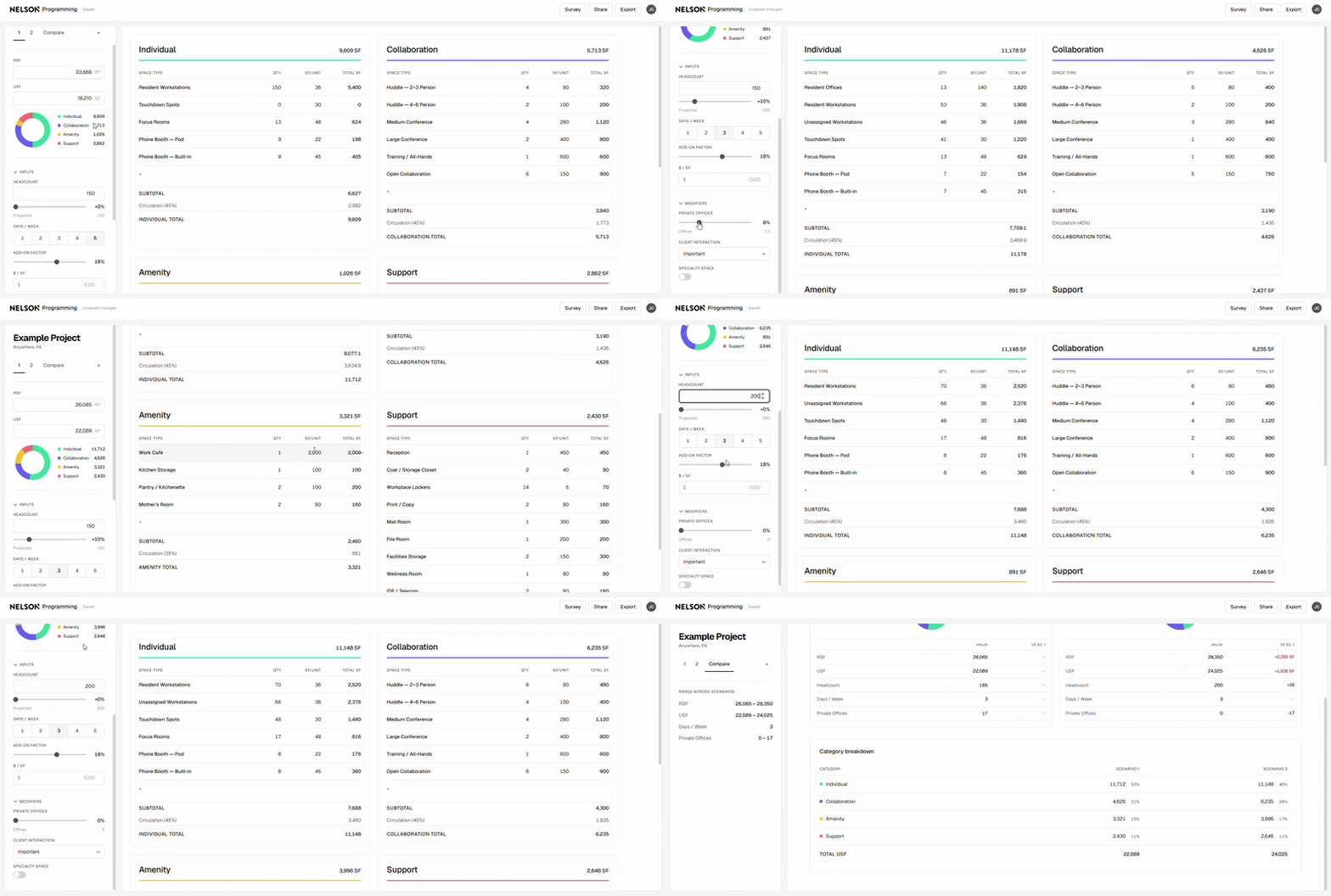
The ratios are built in. No programming by hand.
Start with the big picture, then edit live to explore the details. See what feels right, where you’re unsure, and what still needs an answer.
Compare space needs side by side to see where you could reduce square footage and identify potential savings.
A live blocking session puts our design team in the room with you, bringing your program to life. Less email back-and-forth, fewer test-fit revisions, and the information you need to move forward, fast.
Interactive design session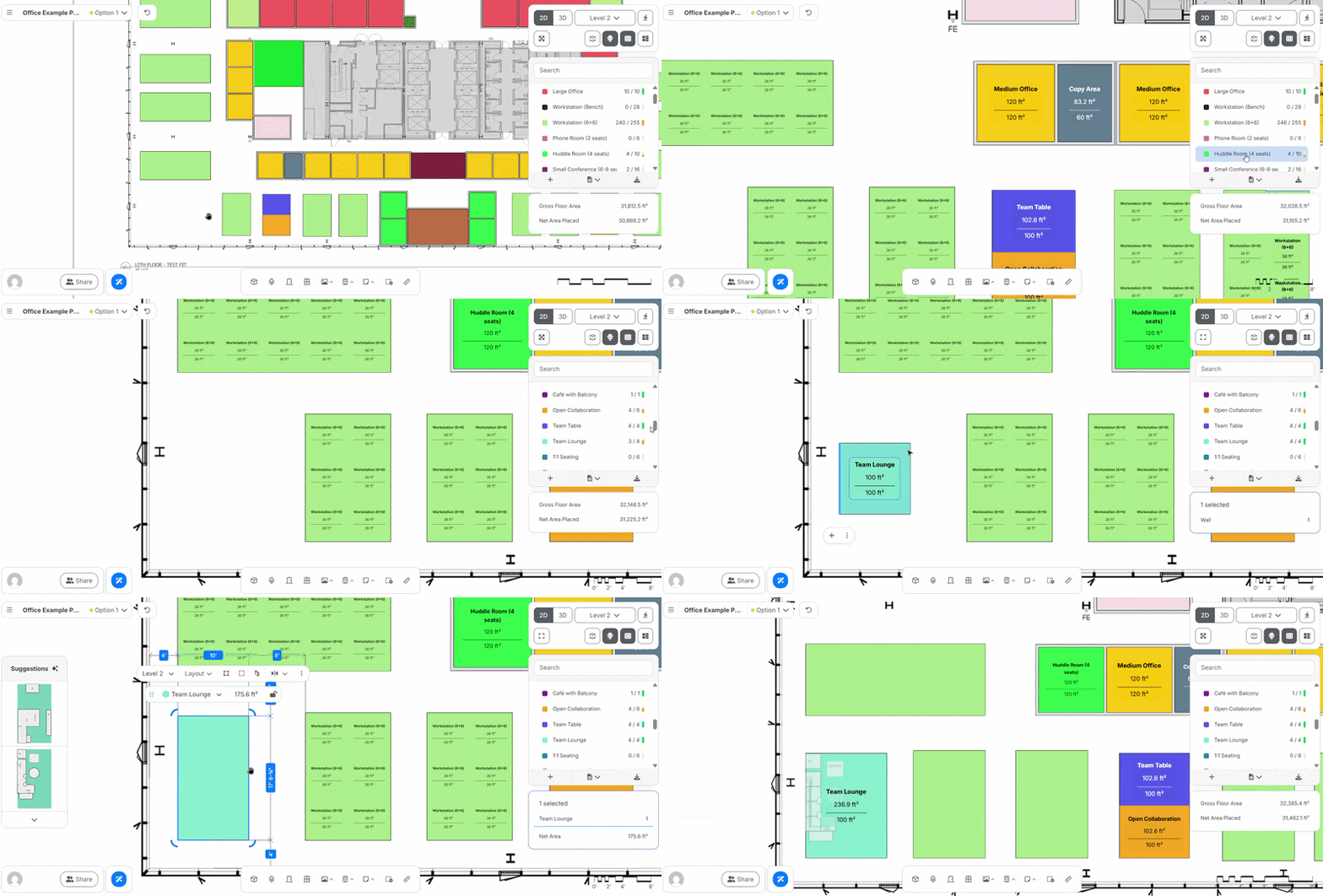
An approved program can mean different things to different people. Working on the plan together brings those differences into view while they’re still inexpensive to resolve.
A collaboration zone is too far from its teams. Circulation doesn’t feel right. Move it together and see the result, without waiting for someone to interpret a comment and return a revised plan.
An incomplete program is enough to begin the conversation. Work through the gaps as you go.
Move a block. Change a headcount. Try another arrangement. If it doesn’t work, move it back.
A plan people can point at helps them explain their priorities—and see whether they agree.
During a live session for an insurance company, the client noticed that a key employee didn’t have a window. It mattered to the team. They raised it in the room, and it was resolved in seconds.
Agree on the plan before committing time to detailed design.
Find Your Shape →A window made a priority visible.
A major insurance company was taking new space in Philadelphia. Department needs were only partly defined, attendance data was missing, and the client expected more changes. We loaded what we had and started working live, in the room.
Midway through the first session, the client stopped us. Peter, a key employee commuting daily from Staten Island, didn’t have a window. That mattered to her team. It came up in conversation and was resolved in seconds.
Afterward, the client sent programming changes to prepare for a second, virtual session. We adjusted the plan together on the call. Hours later, she called with another idea, and we updated it in minutes. By the time the project moved into detailed design, the team had worked through the thinking together.
You can’t comment your way to consensus. Build it in the room.
Find Your Shape →An initial program, built during the conversation.
A professional services firm was considering downsizing its workplace. During a client call, the team suggested finding the existing program: workstation counts, space standards, and the usual mix of conference, support, and amenity space. That would mean another conversation before the work could begin.
Starting with headcount, we generated an initial program in minutes. Prism applied NELSON’s workplace knowledge to establish a starting mix of spaces. Then we worked through it live with the client. They didn’t use phone booths, so we removed them. They didn’t need a large boardroom, so we removed that too. Each change recalculated the program and total square footage.
By the end of the call, we had an initial program. There was no follow-up request to find the old one, no second meeting to review it, and no round of revisions based on notes from the first conversation. The client could use the program to begin looking at available real estate—and keep adapting it as the search progressed.
From “Can we downsize?” to “What space do we actually need?”
Find Your Shape →Eight offices became sixteen—after the test fit was developed.
A major financial client asked NELSON to test fit a workplace plan with eight private offices. After the plan was developed, the client clarified that they needed sixteen. Doubling the office count fundamentally changed the plan. The team had to redo the test fit rather than simply adjust it.
That change consumed additional time and fees. On a smaller project, redoing work can take a significant share of the available design budget. The issue wasn’t a minor detail: the team was developing a plan around an assumption that still needed to be tested.
This is the kind of uncertainty Shape is designed to address earlier. Programming and Live Blocking would let the team compare eight-office and sixteen-office scenarios while the work was still easy to change, understand the implications, and agree on a direction before developing a full test fit.
Spend more time deciding while the work is easy to change.
Find Your Shape →